How to Start Investing with Little Money
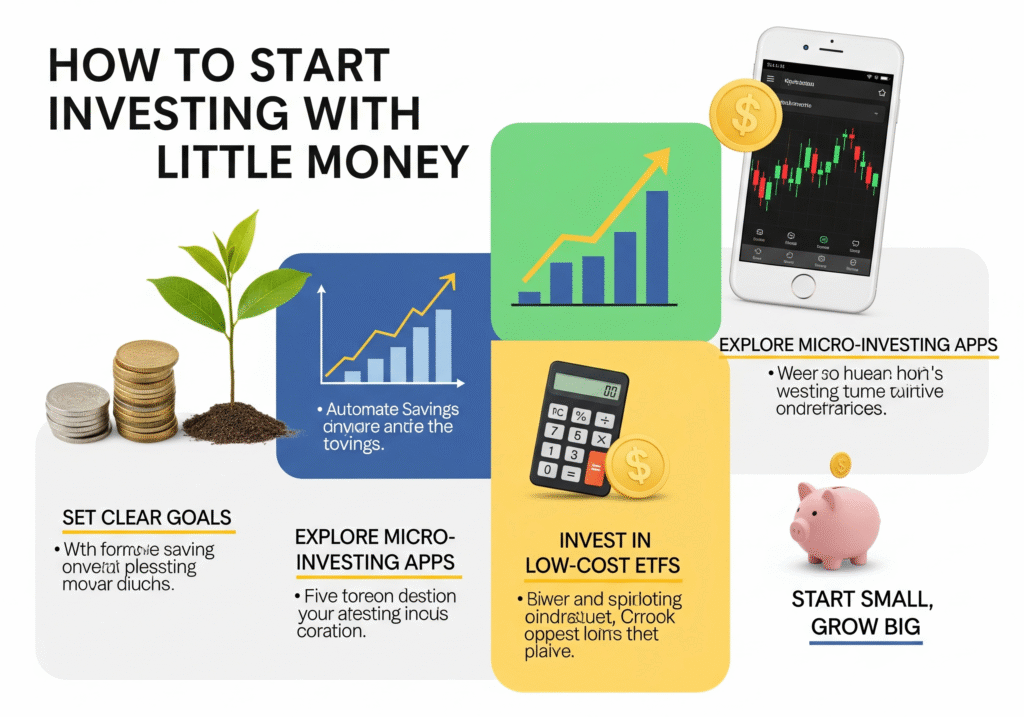
INTRODUCTION OF How to Start Investing with Little Money
It frequently seems like investing is only for those who have thousands of dollars in the bank. Many novices think that in order to begin accumulating wealth, they must first save a significant amount of money. The fact is that you can begin investing without having a large salary. You can get started on the path to financial independence with as little as $50 or $100. We’ll break down realistic, easy, and tested strategies for beginning to invest with little capital in this tutorial.
Why Start Small? AND How to Start Investing with Little Money
It’s better to start small than never start at all. Investing early, even in modest sums, allows you to benefit from compound growth. Because the profits from your investments also begin to generate profits, compound growth enables your money to expand more quickly.
For instance, you may grow over $150,000 in 30 years if you invest just $100 a month and earn 8% annually on average. That is the strength of beginning modestly and maintaining consistency.
Step 1: Set Your Financial Foundation
Make sure you have a strong foundation before investing. What you need is as follows:
- Emergency Fund: Save enough money to cover three to six months’ worth of costs.
- Debt Check: Prioritize paying off credit card debt and other high-interest loans.
- Budgeting: To identify additional funds you can invest each month, use a spreadsheet or budgeting program.
Even $25 to $50 a month can have an impact if this foundation is established.
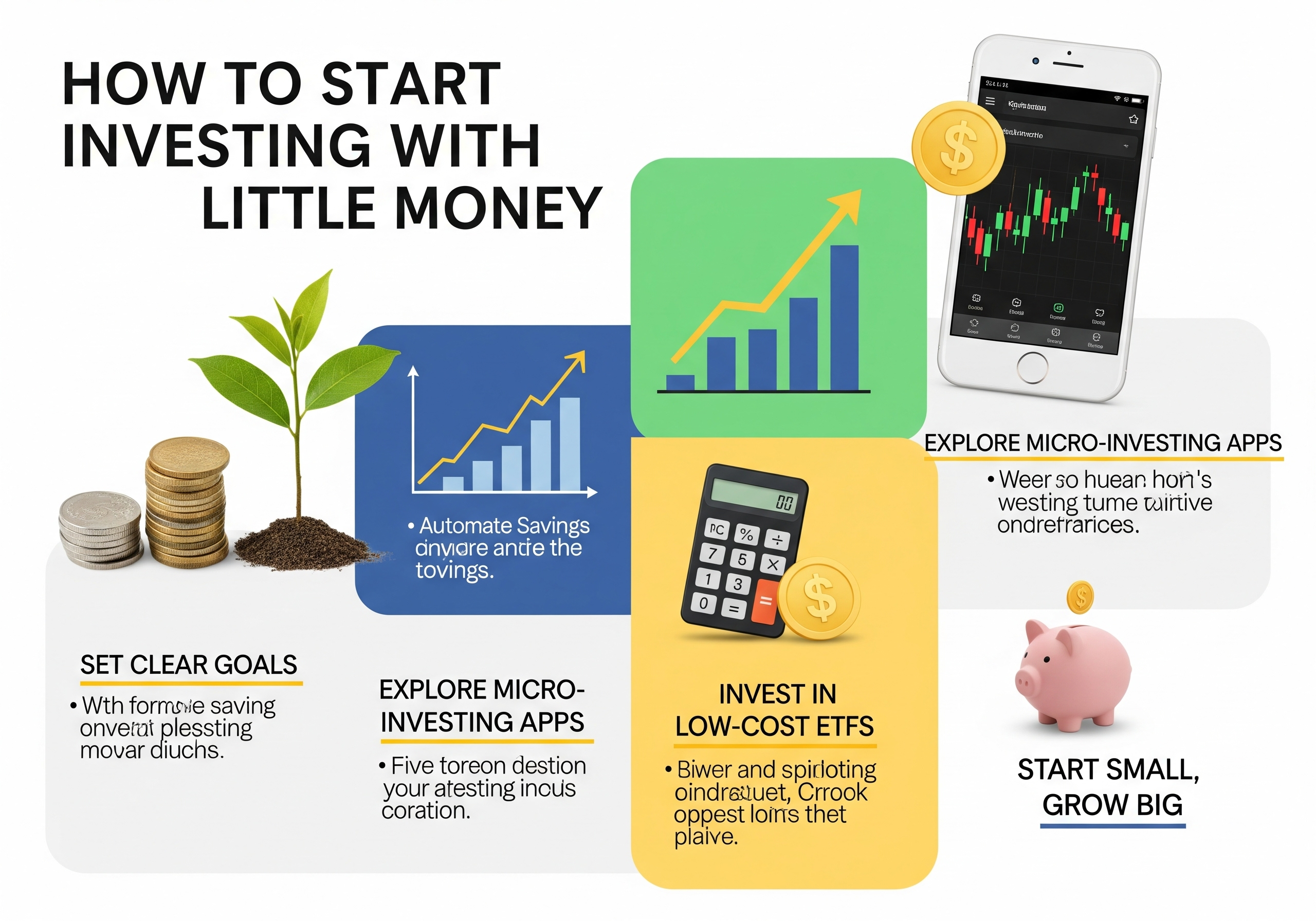
Step 2: Use Micro-Investing Apps
The entry barrier to investing has been eliminated by technology. You may start with as little as $5 using microinvesting applications like Acorns, Stash, and Robinhood. Some apps even round up your regular purchases to invest your extra pennies.
Benefits
- Low initial sum
- Simple to use on a mobile device
- Investing automatically without requiring complex understanding
This is an excellent method for forming the habit of regular investing.
Step 3: Start with Low-Cost ETFs
Exchange-Traded Funds (ETFs) distribute your money among numerous companies, much like baskets of stocks. An ETF allows you to hold hundreds of equities at once, lowering your risk, as opposed to purchasing a single stock like Apple or Tesla.
- The share price of several ETFs is less than $100.
- You can purchase a portion of a share for as little as $1 using apps like Fidelity, Vanguard, and Charles Schwab that enable fractional shares.
- In addition, ETFs are less expensive than mutual funds.
ETFs should be your first choice if you’re just starting off.
Step 4: Consider Fractional Shares
Thousands of dollars are spent on each share of well-known stocks like Alphabet and Amazon. However, fractional shares allow you to purchase a tiny amount of a stock.
For instance, if a share of Amazon costs $3,000, you may purchase $30 worth using applications like Fidelity or Robinhood. In this manner, you can still own stock in well-known companies without having to invest a lot of money.
Step 5: Automate Your Contributions
Automation is one of the best investing practices. Create monthly auto-deposits into your investment app from your bank account. Automating eliminates the temptation to forego investing, even if it’s just $50.
Consider it a bill that you pay for yourself. It develops into a habit that generates actual money over time.
Step 6: Explore Retirement Accounts
Don’t pass on the 401(k) if your work offers one. A lot of businesses will match some of your donations. You can use that money to fund your future.
If you don’t have a 401(k) or are self-employed, think about:
- Pay taxes now, grow tax-free, and take tax-free withdrawals in retirement with a Roth IRA.
- Traditional IRA: Contributions are taxed when they are made, but they are tax deductible now.
Many brokerages allow you to open an IRA with as little as $50.
Step 7: Real Estate Crowdfunding
Believe it or not, you don’t need thousands to start investing in real estate. Platforms like Fundrise and RealtyMogul allow you to invest with as little as $10–$500.
You get exposure to real estate growth without needing to buy property. This diversifies your portfolio and adds another income stream.
Step 8: Don’t Chase Quick Riches
It’s tempting to search for “get rich quick” ideas like meme stocks or cryptocurrency excitement when you don’t have a lot of money to start with. They carry significant dangers even though they might yield quick profits.
Adhere to long-term, tried-and-true solutions such as retirement accounts, fractional shares, and exchange-traded funds (ETFs). Gambling is inferior to consistency.
Step 9: Learn Continuously AND How to Start Investing with Little Money
Your best investment, even if you have little money, can be in yourself. Listen to podcasts, read books about finance, and follow reputable blogs. Finding better possibilities and avoiding blunders are made easier with knowledge.
A few resources for beginners:
- Benjamin Graham’s The Intelligent Investor
- Ramit Sethi’s “I Will Teach You to Be Rich”
- The “BiggerPockets Money” podcast
Step 10: Start Now AND How to Start Investing with Little Money
The biggest mistake beginners make is waiting until they “have more money.” Time in the market is far more important than timing the market. Even $10 today is better than $0.
Think of investing as planting a tree. The earlier you plant, the bigger it grows.
Conclusion OF How to Start Investing with Little Money
To begin investing, you don’t need thousands of dollars. You can start with as little as $5 by using retirement accounts, fractional shares, ETFs, and microinvesting apps. Patience and constancy are crucial.
Every dollar invested now contributes to future financial independence. Let your money grow with you by starting small and doing it now.
how-to-build-passive-income-in-2025
best-long-term-investments-2025